

5-minute read
written by
Petr Kašík
category
tags
Fragile RNA means fragile analysis.
Anyone who has ever worked with RNA knows the drill: instability, low yields, degradation, wasted samples, and repeat analyses. Even when everything went according to plan. Even when you did everything possible to protect your RNA.
Whether your specialty is RT-PCR, RNA-seq, cDNA library prep, or work with clinical samples, RNA quality often determines result quality. Unlike DNA, it is extremely prone to degradation, most often because of ubiquitous RNases. You’ll find them on lab surfaces, in reagents, and in many biological samples, and they only have one job: to destroy your RNA. Even low RNase activity can reduce yield, lower detection sensitivity, or completely wipe out a valuable sample.
That is why RNase inhibitors have become a standard part of many RNA assays. Their job is to block RNases before they can damage the sample, keeping RNA intact during isolation, reaction setup, reverse transcription, and other downstream analyses. But this is where a problem often left unspoken arises: common RNase inhibitors are themselves highly unstable and lose activity. And that loss can happen silently, in the background of the experiment.
So what if the problem is not the sample, but the very mechanism meant to protect it? How can RNA be protected as thoroughly as possible? ⬇️
In the article, you will learn:
🔵 What inhibitor oxidation is and why it ruins your results?
🟠 How can you preserve inhibitor activity even after repeated freeze-thaw cycles?
🔵 Why does temperature matter in reverse transcription?
🟠 Can inhibitor stability be maintained even at room temperature?
🔵The key to RNA protection? An inhibitor resistant to oxidation
The most effective way to protect RNA is to add protein RNase inhibitors, which protect it by blocking ubiquitous RNases. Their advantage is their enormous inhibitory power, but all known inhibitors have one major weakness: they are very unstable and easily lose activity. The result is unreliable analysis, data loss, and damage to the entire experiment. How and why does this happen?
Their activity can be lost easily, without you doing anything wrong. Mammalian protein RNase inhibitors are extremely sensitive to oxidation. Once that happens, they quickly lose the ability to block RNases. This occurs surprisingly easily and quickly, for example at slightly basic pH, in the range commonly used for RNA applications, but also during storage or after repeated freezing and thawing. That is why DTT is added to buffers. Unfortunately, RNase inhibitors are so sensitive that even DTT cannot save their activity. At the same time, DTT itself is highly unstable. Inactivation of RNase inhibitors due to oxidation therefore represents a serious and unresolved problem, and current RNase inhibitors cannot reliably protect RNA.
Our RNase inhibitor, DB Ultima H, does not need to rely on DTT. Thanks to its extreme resistance to oxidation, it does not lose effectiveness or activity, helping protect RNA even under conditions where conventional inhibitors fail.
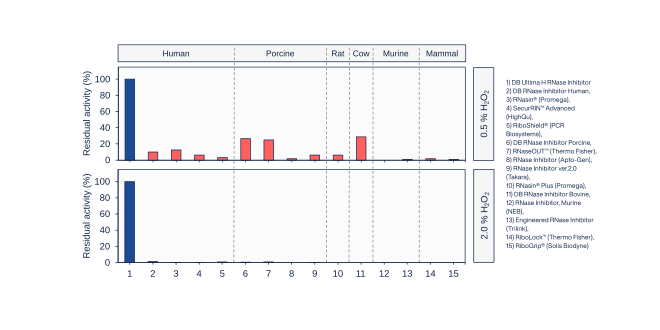
You can see for yourself in our extensive comparative study, where we compared DB Ultima H against 14 other available inhibitors. We tested the activity of all inhibitors after brief exposure to an oxidizing agent (H₂O₂), and DB Ultima H remained the only active one ⬇️.
4 tips for resilient RNA:
🔵 RNases are everywhere: Work quickly and cleanly.
🟠 From sample collection to the final step: RNA must be protected from start to finish.
🔵 Low temperature matters. But working on ice alone won’t save you.
🟠 And most importantly: use a reliable inhibitor. For example, DB Ultima H 🙏
🟠 Basic pH, repeated thawing, or storage on ice. All of these can destroy the inhibitor.
What does oxidative resistance offer? Can it also solve other stability issues with RNase inhibitors? Our data says yes!
In real-world RNA assays, users end up damaging RNase inhibitors themselves. They do not do it on purpose; it is simply inherent to the assay. They often expose them to slightly alkaline pH, repeated freezing and thawing, storage on ice, or different conditions during cDNA synthesis and RT-PCR. As a result, the inhibitor becomes less stable, more prone to oxidation, and quickly loses its ability to block RNases. This happens especially above pH 8, which is commonly used in cDNA synthesis and RT-PCR mixes. That means the inhibitor can fail precisely under the conditions where reliable RNA protection is needed most.
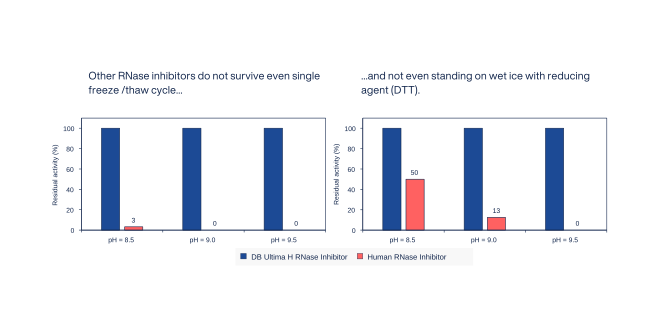
To verify whether oxidative resistance also improves stability in these situations, we compared DB Ultima H with conventional RNase inhibitors at different pH values, after repeated freeze-thaw cycles, and during short-term storage on ice. The difference was striking: the original human RNase inhibitor lost approximately 97% of its activity after a single freeze-thaw cycle at pH 8.5, and at pH 9.0 or higher it showed no activity at all. By contrast, DB Ultima H retained approximately 100% activity across the entire tested pH range.
The same trend was seen during storage on ice. RNaseOUT and the human RNase inhibitor retained only about 50% activity after one day at pH 8.5 and less than 1 % at pH 9.5. DB Ultima H, on the other hand, remained fully active under all tested conditions, showing that DB Ultima H not only resists oxidation, but turns that property into more reliable RNA protection in real-world conditions.
🔵 Higher temperature, higher yields. The inhibitor’s thermostability is key for RT.
Temperature is important in reverse transcription, and the optimal range is between 50 and 65 °C. Low temperatures can leave RNA folded, and the reverse transcriptase may then not read the RNA properly. The result is incomplete cDNA or lower yield.
RNase inhibitors therefore must be able to protect RNA at temperatures of 50 °C and above. With standard inhibitors, activity drops rapidly under these conditions, so RNA protection can fail precisely during a key step of the experiment. In our comparison, none of the tested conventional inhibitors retained activity at 55 °C, and many did not even at 50 °C. DB Ultima H was the only one that remained fully active after 5 minutes at 55 °C.
It also retained activity after 1 hour! Thanks to its higher thermostability, DB Ultima H helps reliably protect RNA even in more temperature-demanding applications such as cDNA library prep, one-step RT-PCR, or RNA-seq.
🟠 Stability at room temperature? No problem.
Stability at room temperature is hard to imagine for protein-based RNase inhibitors. But it would certainly make day-to-day work easier and provide reliable RNase inhibition.
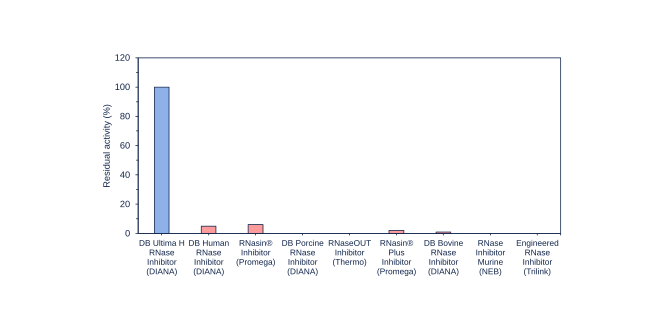
DB Ultima H can do it. In our tests, it remains stable at room temperature not only as a concentrated stock protein, but also at low concentration in RT-PCR buffer, even without DTT. No other inhibitor we tested could withstand these conditions.
In addition, DB Ultima H in glycerol stock form retains full activity for at least two months even at higher temperatures (for example, 37 °C), opening the door to easier handling, storage, and shipping at ambient temperature.
🌡️ Easier shipping: DB Ultima H inhibitor is sent unfrozen!
🔵DB Ultima H: The inhibitor you can trust🟠
DB Ultima H combines exceptional oxidative resistance with high stability across relevant conditions and greater thermostability. It works without DTT, remains active across a wide pH range, and keeps working where standard inhibitors fail: during storage, under different reaction conditions, or in more demanding RNA workflows. Thanks to effective inhibition of a broad spectrum of human RNases, it is especially well suited for RNA protection in human samples.
The result is an RNase inhibitor you can rely on even in situations where sample stability and protection are critical. And one that truly protects your fragile RNA.
Download the booklet in PDF ➡️DB Ultima H Booklet
Follow DIANA Biotech for more molecular biology insights on LinkedIn
Looking for our products? Check our expanding distribution network ➡️ Distributors