

3-minute read
written by
Petr Kašík
category
tags
Life Science
Reverse transcription is often the limiting step in RNA workflows, especially when working with complex templates, long transcripts, or low-abundance targets. With our DBscript Reverse Transcriptase we had already provided a reliable, high-performance solution, combining robust cDNA synthesis, streamlined workflows, and strong performance across a wide range of applications. It consistently matched or outperformed widely used competitor enzymes in speed, yield, and thermostability.
Now, we introduce its next-generations: DBscript 2.0 and DBscript Turbo, engineered to push these advantages even further.
Built on the proven M-MLV mutant platform with reduced RNase H activity, both enzymes deliver fast and efficient cDNA synthesis at elevated temperatures, helping to overcome RNA secondary structures and improve both yield and specificity.
Two Solutions for Different RNA Challenges
Modern RNA applications demand more than just reliable reverse transcription. High sensitivity, fast turnaround, and compatibility with difficult templates are essential, whether in RT-qPCR, diagnostics, or library preparation.
The new DBscript enzymes address these challenges directly with two different approaches:
DBscript 2.0 has been optimized as the go-to enzyme for routine workflows where sensitivity is critical. It enables reliable detection of extremely low RNA inputs, down to ~ 1-copy targets, while maintaining strong performance across standard RT-PCR applications. With improved speed and thermostability, it supports reverse transcription at temperatures up to 65 °C without compromising efficiency, helping to reduce nonspecific interactions and improve overall assay quality.
In contrast, DBscript Turbo is designed for speed and processivity. It is the preferred choice for long RNA templates and time-sensitive workflows, delivering rapid cDNA synthesis even for transcripts longer than 5 kb. Its high processivity and optimized kinetics enable efficient full-length cDNA synthesis, making it particularly suitable for applications such as RNA-seq library preparation.
Faster Reactions, Higher Throughput
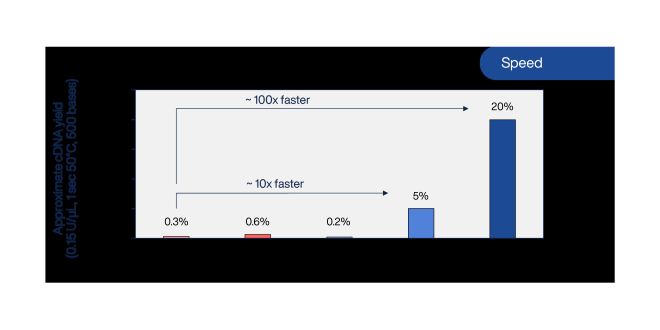
Speed is one of the most noticeable improvements in the new DBscript generation. Both enzymes significantly accelerate reverse transcription workflows, enabling meaningful cDNA synthesis in dramatically shorter incubation times compared to conventional RTs as you can see on our comparative study.
DBscript 2.0 delivers rapid performance for routine assays, while DBscript Turbo is engineered for maximum reaction speed, supporting fast protocols without compromising yield or quality. This increased speed translates directly into higher throughput, shorter turnaround times, and greater flexibility in experimental design.
Thermostability: High Yields up to 70 °C
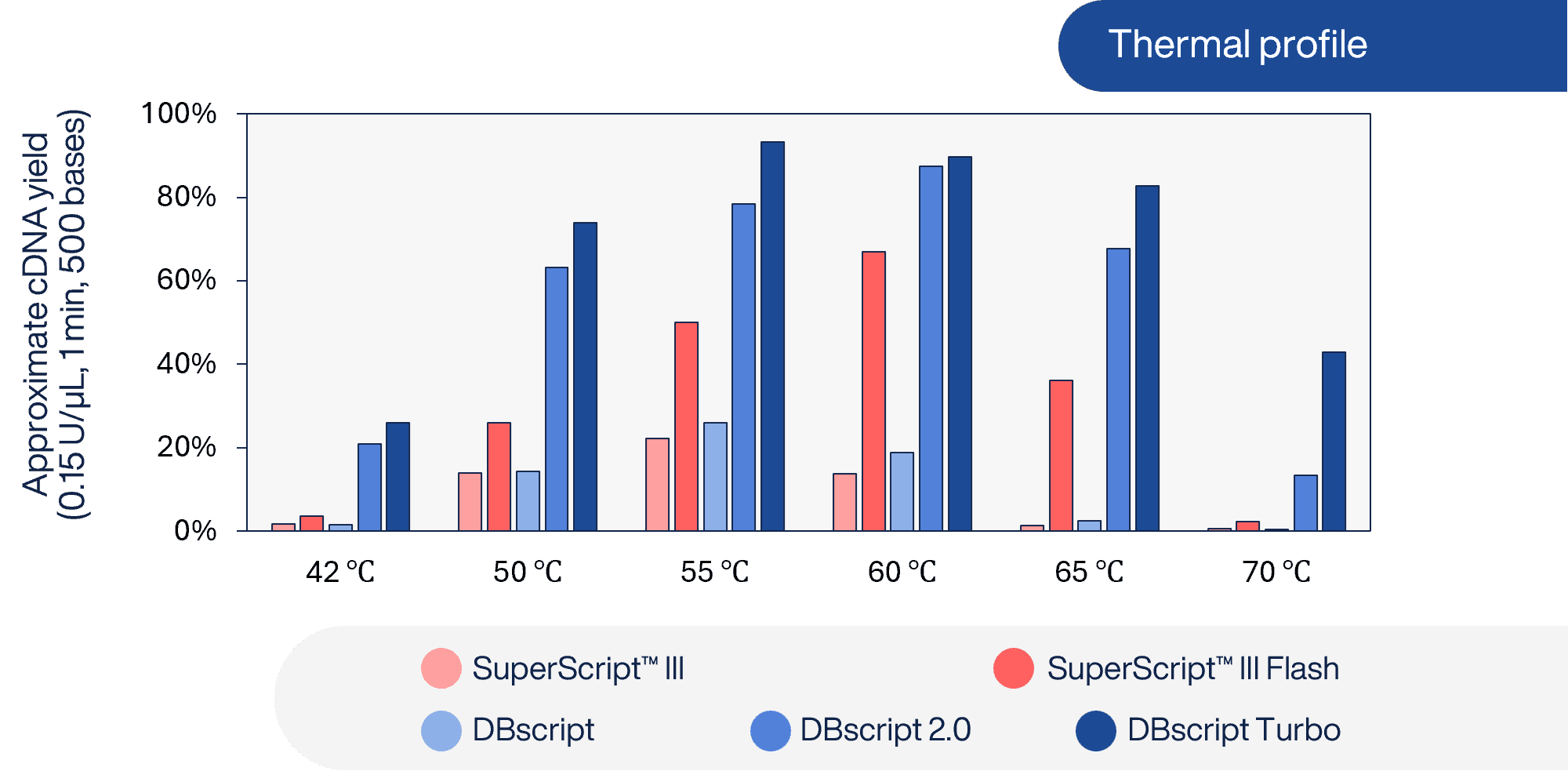
A defining feature of DBscript enzymes is their ability to operate efficiently at elevated temperatures. Higher reaction temperatures reduce RNA secondary structures, improving accessibility of the template and leading to more complete and accurate cDNA synthesis.
Both DBscript 2.0 and Turbo maintain the highest activity in the 50–60 °C range and up to 70 °C, supporting more robust performance across a variety of RNA types, including GC-rich and structurally complex templates.
This enhanced thermostability not only improves yield, but also increases specificity, an essential advantage in sensitive applications such as diagnostics and multiplex RT-qPCR.
Two Ways for Maximum Sensitivity
In addition to speed and robustness, the new DBscript enzymes offer exceptional sensitivity across a wide input range. cDNA synthesis can be performed from very low to high RNA inputs, making the enzymes suitable for both challenging low-abundance samples and standard workflows.
DBscript 2.0 excels in applications where maximum sensitivity is required, while DBscript Turbo combines high sensitivity with superior processivity, ensuring reliable performance even for long and complex targets.
Choose the Right Enzyme
Both enzymes share a common foundation of high performance and reliability, but are optimized for different priorities.
Together, they provide a flexible platform that can be tailored to virtually any RNA workflow. Explore the products to find the best fit for your application!